Chapter 10 - THE STAIRCASE AFTERWARD
Chapters · 10 of 10
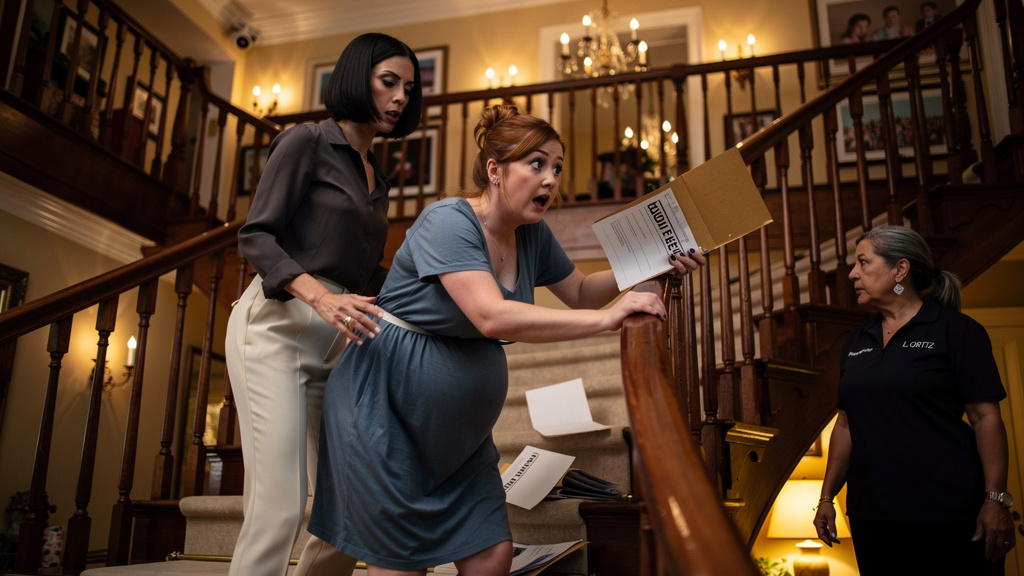
Vanessa was not convicted the following morning.
Life did not resolve itself that neatly.
The investigation lasted eleven months.
The outside audit documented $2.43 million in unauthorized transfers from the Parker Relief Fund, falsified approvals connected to Rivergate Towers, payments routed through Harbor & Finch, and undisclosed financial ties between the contractor and Adrian Bell.
Prosecutors eventually charged Vanessa and Adrian with offenses involving fraud, falsification of business records, and conspiracy.
Vanessa's attorneys contested several charges.
Some counts changed before trial.
Others survived.
What never changed was the paper trail.
The original ledgers.
The freight records.
The engineering reports.
The security footage.
And the torn piece of Emily's audit notes recovered from Vanessa's vehicle.
The staircase incident became a separate criminal matter.
Vanessa continued insisting she had intended only to stop Emily and seize the folder, not send her down the stairs.
Emily never claimed to know what had existed in Vanessa's mind during that fraction of a second.
She didn't need to.
She knew what Vanessa had done.
A hand had been placed against her back because she refused to surrender evidence.
The consequences belonged to the act, not to whatever safer intention Vanessa later invented.
Rivergate Towers mattered more.
Independent inspections found that Building Three required immediate structural reinforcement. Residents were temporarily relocated at Parker Civic Development's expense.
Nobody was injured.
That fact became the sentence Grant repeated whenever the financial cost frightened the board.
Nobody was injured.
This time.
He refused to let luck become a defense.
The company publicly disclosed the failure, commissioned independent reviews of every active residential project, and separated the Parker Relief Fund completely from company management.
The foundation received full restitution.
Not from future donations.
Not from insurance intended for someone else.
The Parker family sold two nonessential investment properties and contributed enough private money to restore every diverted dollar while civil proceedings determined what additional sums could be recovered.
Margaret sold one of them herself.
It was a lake house she had owned for thirty-one years.
“I should have asked what 'handled' meant,” she told Emily the day she signed the papers.
Emily didn't tell her she was forgiven.
That would have been dishonest.
Margaret had not pushed her.
But she had helped create a family culture where protecting the name mattered more than asking how the protection was achieved.
Forgiveness, Emily learned, was less meaningful when given before accountability had finished doing its work.
Margaret accepted that.
Their relationship became quieter.
Stranger.
And eventually more truthful.
Grant stepped down from daily operations for four months during the independent review.
The board had not required it.
He did.
He had discovered that ignorance could still be a management failure when a person benefited from not asking questions.
That lesson cost him.
Emily loved him more for accepting the cost than she ever would have loved a speech claiming he had done nothing wrong.
They moved out of the mansion before Nora was born.
Not because Emily was afraid Vanessa would return.
Vanessa was prohibited from the property while the investigation continued.
They moved because the house had become a monument to generations of decisions made behind closed doors.
Grant bought nothing grand.
They rented a brick house fifteen minutes from the city, with three bedrooms, a small yard, a kitchen Emily immediately complained was badly designed, and exactly fourteen stairs.
The first week, Grant offered to convert the downstairs office into a temporary bedroom.
Emily knew why.
“No.”
“You don't have to prove anything.”
“I'm not.”
“You've avoided stairs for six weeks.”
“I know.”
He waited.
Emily stood at the bottom.
Trauma was strange.
She could review evidence from the incident without shaking.
She could describe Vanessa's hand to investigators.
She could watch the security footage.
But certain sounds still reached her before reason did.
Wood creaking behind her.
A sudden footstep.
A palm brushing fabric.
Her body remembered the fall that never happened.
Grant did not reach for her.
That mattered.
He stood nearby and let the choice remain hers.
Emily took the first step.
Then another.
Halfway up, Nora shifted inside her.
Emily smiled.
“I know.”
Grant looked up.
“What?”
“She apparently has an opinion.”
“When doesn't she?”
Emily reached the top.
There was no triumph.
No music.
No magical disappearance of fear.
Just a hallway.
That was enough.
Nora Parker was born nineteen days later at 7:12 in the morning, six pounds eleven ounces, furious about the temperature of the world and equipped with lungs capable of alarming nurses from two corridors away.
Emily cried before the baby reached her chest.
Grant cried harder.
For several hours, neither mentioned Vanessa, Rivergate, the company, the mansion, or anything else that had consumed their lives.
Nora wrapped five tiny fingers around Emily's index finger.
That was the whole world.
Months later, Emily returned to work gradually.
She did not become Parker Civic Development's CFO.
She refused when the board floated the idea.
“I enjoy being invited to Thanksgiving occasionally,” she told them.
Instead she rebuilt her independent forensic-accounting practice and accepted a paid role on the Parker Relief Fund's new external compliance committee, where no Parker family member could approve or redirect grants alone.
Samuel Greene became the foundation's independent auditor.
Priya Shah was hired by a separate engineering firm to participate in Rivergate's final certification.
Lena's niece returned to Building Three only after Priya personally signed the structural clearance.
Lena framed a copy.
Emily discovered it in the house manager's office one afternoon and laughed until she cried.
The old mansion changed too.
Margaret remained there.
Grant visited.
Emily visited eventually.
The first time she returned, Nora was almost nine months old.
Lena opened the front door and immediately stole the baby from Grant's arms.
Margaret came from the drawing room with tears already in her eyes.
Nothing about the moment was perfect.
That made it real.
Emily walked into the foyer.
Then she saw the staircase.
The polished railing had been repaired where her grip had damaged the finish.
The security camera remained above the landing.
Margaret noticed where she was looking.
“I asked whether you wanted it removed.”
Emily shook her head.
“No.”
For a long moment she stood exactly where she had stood after catching herself.
She remembered Vanessa behind her.
The falling papers.
Lena running.
Grant arriving.
The sickening uncertainty before Nora moved beneath her hand.
Then Emily looked down at her daughter.
The camera had answered one question.
It had shown the hand.
But cameras could only preserve actions.
They could not explain the years of fear, pride, loyalty, money, silence, and compromise that made the hand move.
That had taken much longer to uncover.
Emily touched the banister.
Nora reached toward it too.
Emily smiled and let her tiny hand rest beside hers.
The staircase no longer felt like the place where everything almost ended.
It was the place where concealment failed.
And for the first time since that night, Emily walked upstairs without looking behind her.